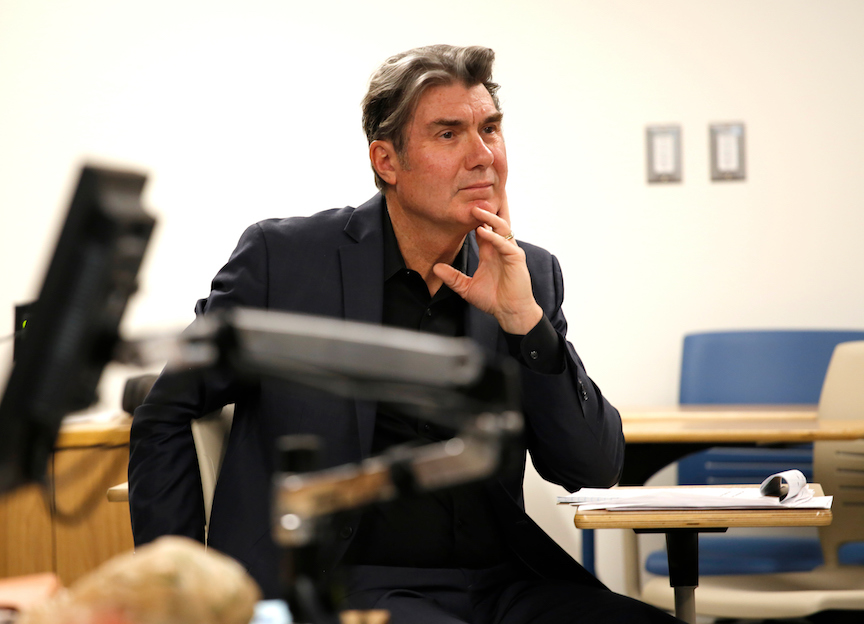
Religion Professor Mark Wallace describes his research and writing as “an exercise in the emerging field of religion and ecology—a promising new line of inquiry in religious studies. The profound theological questions posed by most if not all human cultures are now seen as questions that have direct bearing on ecological understanding. Questions such as, Are human beings part of or beyond nature? Do human beings have obligations to other life forms? Does the cosmos have an inherent purpose or function? are questions that are alternately religious, moral, and ecological at the same time. These are the questions that animate my writing, especially in regard to the role Christianity has played in both deepening, and ameliorating, the environmental crisis in our time.”
Mark Wallace is the author of When God Was a Bird: Christianity, Animism, and the Re-Enchantment of the World, (Fordham University Press, 2018), Finding God in the Singing River: Christianity, Spirit, Nature (Fortress, 2005), Fragments of the Spirit: Nature, Violence, and the Renewal of Creation (Continuum, 1996; Trinity, 2002), and The Second Naïveté: Barth, Ricoeur, and the New Yale Theology (Mercer University Press, 1990, 1995), edited Paul Ricoeur’s Figuring the Sacred: Religion, Narrative, and Imagination (Fortress, 1995) and co-edited Curing Violence: Essays on René Girard (Polebridge, 1994). He has also written numerous articles on all of the topics above.
He received a 2003-04 Andrew W. Mellon New Directions for Scholars-Teachers Fellowship which allowed him to initiate community-based learning into his Religion, the Environment, and Contemplative Practice course and forge an ongoing partnership between his classes and several community organizations in Chester, Pa.Professor Wallace received his B.A. from the University of California at Santa Barbara, his M.Div. from Princeton Theological Seminary, and his Ph.D. from the University of Chicago.
MORE HERE: https://www.swarthmore.edu/profile/mark-wallace